The Agent for Companies of the Future
Writing code is no longer the bottleneck. How your company builds, ships, and operates is. Amp moves with the frontier, and your company moves with it.
Everything Your Agent Should Give You
It all works out of the box. To us, this is the baseline.
Orbs
Every agent gets its own cloud computer. Close your laptop; it keeps working.
Build iOS and Mac Apps
A macOS Satellite builds and tests your app on a Mac in the cloud, and Amp ships it to TestFlight. In beta.

Puck
Ask Puck to start agents and check on tasks, by text or by calling.

Portals
Whatever runs in an orb gets a live URL. Test and share work in progress from your phone, without a local checkout.
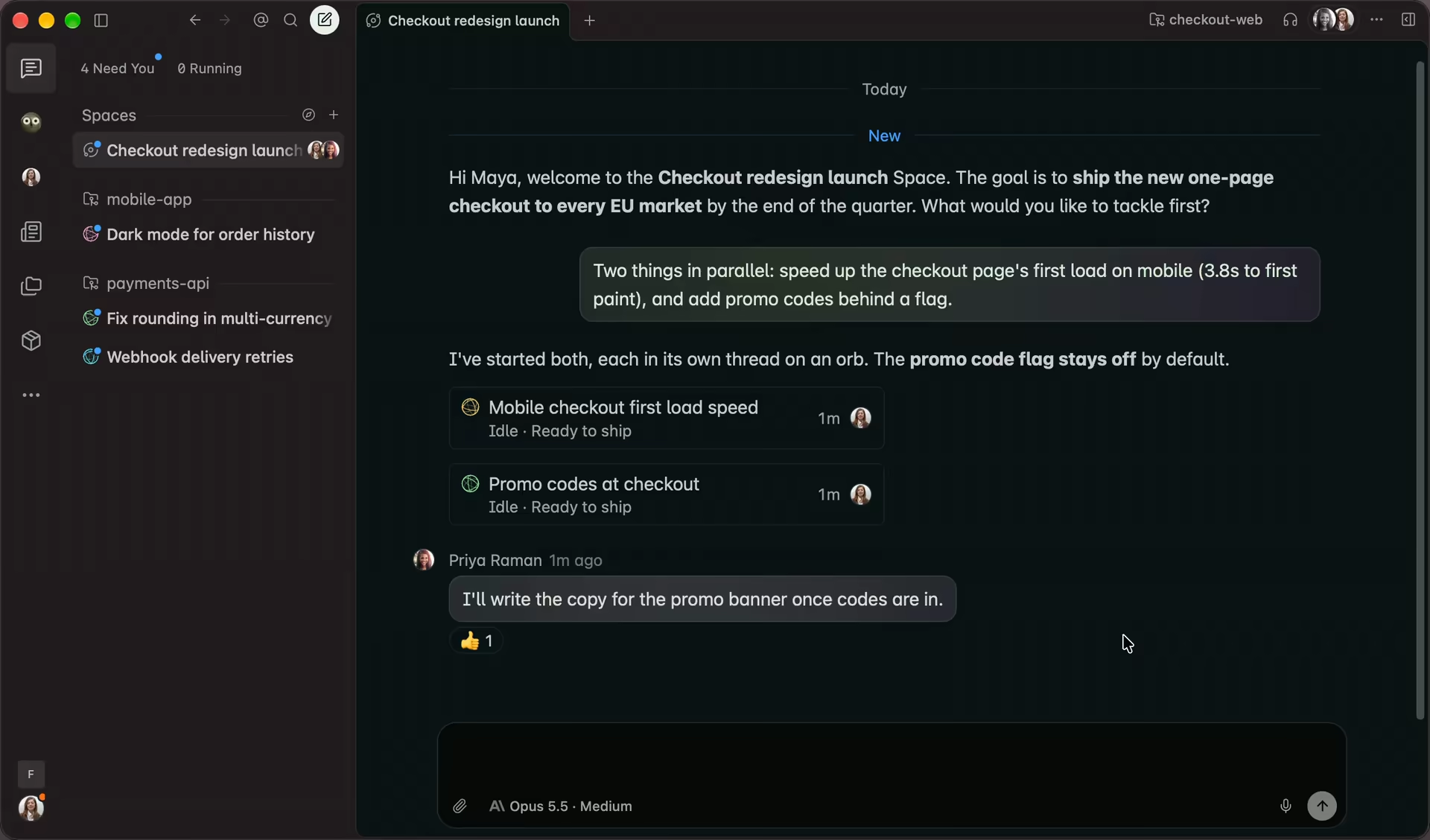
Spaces
One agent coordinates a fleet of threads, teammates, and artifacts, so you stay in the captain’s chair.
Boxes
Always-on computers for the internal software you build on the spot, with an agent running in production.
Automations
Agents wake on schedules, webhooks, CI failures, Linear issues, GitHub and GitLab events, and Slack.
Multiplayer
Pull teammates straight into a live thread and its orb, and prompt the agent together.
Every Client
Native apps for Mac, iPhone, iPad, Android, Windows, and Linux, plus the web and the terminal. Keep shipping from anywhere.
Plugins and Models
Wrap any internal API in a plugin, or extend Amp with more capabilities, like /btw. Use frontier models from several labs, or bring your own ChatGPT or Claude subscription.
Always on the Frontier
Amp is written by Amp. The ampcode.com server ships to production about 90 times a day. A new model drops every two weeks or so. We like our odds.







“Use It, and Be Ruined”
Adam Wathan, Creator of Tailwind CSS
“Building software in anything other than @AmpCode orbs feels like eating broken glass in comparison. But it’s frustratingly one of those “you can’t understand why it’s better until you just use it” tools, a lot like Tailwind was. Use it, and be ruined.”
“If I bought a new laptop today, I don’t think I would install any local dev tools / languages at all. … I think I could do everything I currently do with nothing but Laravel Cloud and @AmpCode Orbs.”
“I’m at the “do I even need a computer?” stage of using @AmpCode”
“currently sitting in a chair rocking my youngest to sleep for a nap watching 3 orbs work from my phone”
“we spent longer than we should’ve setting up Cursor cloud agents earlier this year … and then Amp comes out with orbs and they Just Work™”
“it is indeed Orb’in time. the @AmpCode folks have cooked. Making new orbs is so easy and really unlocks a lot of the multi-agent behaviors that had just a tad too much friction before.”
“orbs have completely changed the way I work. I can’t imagine going back to working locally at this point.”
Other Builders Agree
 Georgios Konstantopoulos CTO, Paradigm
it’s really hard to understate how ahead of the curve @AmpCode was in january
 Peter Steinberger Creator of OpenClaw
agree. orbs were the metric. made cloud sessions as good in OC now. I understand now how hard this was!
 Alexander Embiricos Codex lead, OpenAI
punching way above its weight
 Mario Zechner Creator of pi
Amp is crazy good, the Porsche of CLIs.
 Sebastian Szturo @SebastianSzturo
Amp are the 37signals of our time.
 Adam Wathan Creator of Tailwind CSS
It is so obviously the closest to what the future of building with agents (especially on teams) looks like. Threads are the new PR, and everyone on the team should be able to see them.
 Ray @ray_barrera
their team is cracked in ways that will make you wonder why some other teams are 10-20x bigger (while delivering 1/10th the progress).
You Aren’t Buying a Snapshot. You’re Buying a Ride.
Every two weeks, the models jump and old workflows expire.1 Meeting users where they are in 2026 means stranding them in the past. We kill our old forms before anyone else will.
A graph of the work on Amp each day of 2026: what was built above the line, what was removed below it. The pace rises through the year.
-
Early 2026
Removed TODO lists, Fork, custom commands, and tab completion, then our own VS Code and Cursor extensions.
- Jan 12 TODOs Are Done →
- Jan 13 Stick a Fork in It, It's Done →
- Jan 15 Tab, Tab, Dead →
- Jan 29 Slashing Custom Commands →
- Feb 19 The Coding Agent Is Dead →
-
Mid 2026
Rebuilt Amp on a new architecture, then left local laptops and git worktrees behind for cloud orbs, portals, and multiplayer threads.
- May 6 Amp, Rebuilt →
- Jun 2 The End of Public Threads →
- Jun 30 Agents in Orbs →
- Jul 22 Multiplayer →
- Aug 6 Portals into Orbs →
- Aug 27 So Long, TUI Sidebar →
-
Late 2026
Moved past single threads to Spaces, past cloud deploys to always-on Boxes with agents in production, and shipped self-hosted orbs.
- Oct 22 Self-Hosted Orbs →
- Nov 6 Spaces →
- Nov 10 Boxes →
- Nov 12 Bye Bye, Dial →
1 Fourteen frontier models went live between July 1 and November 3, 2026, one every nine days (ArtificialWatch). The length of task they can finish doubles about every 3.6 months (METR).
How We Work, and What We Believe
We don’t just talk the talk, we also walk the walk.
The full manifesto is at amplabs.com. There is more in Thorsten’s post and on Raising an Agent.
21
people, one team
~90
deploys per day
7.7 min
from main to live
No mandatory pull requests.
Because code review will die.
Small changes go straight to main behind feature flags. The agent proves each one end to end, with screenshots and video, before a human looks.
No departments.
Because the triad of PM, design, and engineering will disappear.
No executives and no territory either. Everyone can do everything.
No PRDs.
Because most bugs won’t be coding bugs.
No design documents written up front. Whoever has the idea shows how it could work, and we decide from that.
No quarterly goals.
Because winners will reorganize around models.
A six-month plan doesn’t survive a new model that drops tomorrow. On Monday the whole team meets and writes down its goals for the week.
Now we’re taking this way of working into the real economy.
Every Serious Institution Needs a Camp at the Frontier
Amp Labs puts small teams of builders inside a single company per industry and region. We win if and only if they win. The first is Westpac, Australia’s oldest bank.
Amp Labs 01
 Gareth Townsend Previously Block
 Matty Evans Previously Ethereum Foundation
 Andrew Gerrand Previously Google
 Chris Nicol Previously Canva
 Ryan Christensen Previously Canva
 David Goodlad Previously Qsic
 Anthony Marcar Previously Zable Health
 Oz Nova Previously Bradfield
Westpac’s Intranet Migration
“Our partnership with Amp is unlocking a huge amount of value in engineering. … This is a project that typically would cost low seven figures to achieve and take about a year. We were able to complete that with a cost of $12,000 USD in tokens. Obviously, the ROI there is very clear.”
The St.George Data Warehouse Migration
“This helped us complete the migration more than two years earlier at half the cost.”
Join Us on the Frontier
Bring Your Company
Talk to the team about rolling Amp out, or see how Amp Labs works inside companies like Westpac.