
Time Capsules
Recordings of Brett working with Amp, from the Chronicle.
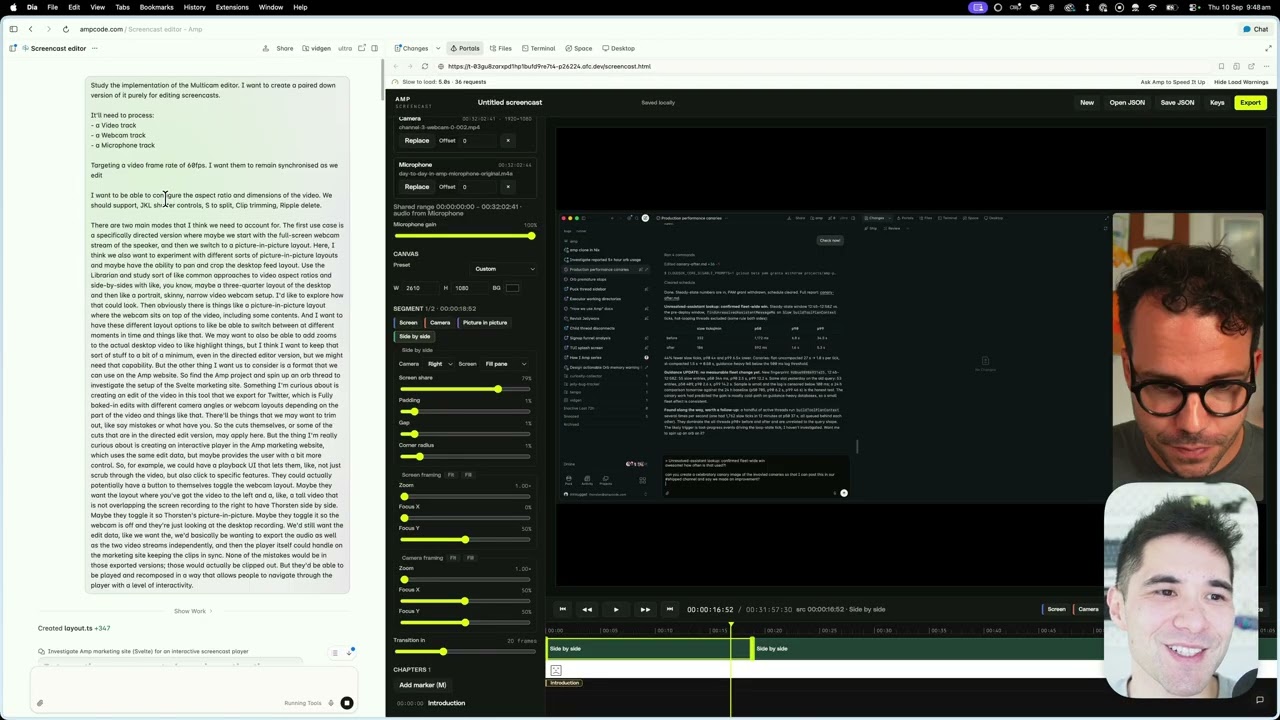

Pinboard
Notes, dispatches, and things Brett made in orbs.
Where do you talk to Amp most: terminal, editor, web, phone, Slack?
Mac app/web app, then iPhone. I’ll spawn an orb thread from a Slack conversation a couple of times a
day, and I use the terminal occasionally (once a week to update my local dev env) though mostly with amp --no-tui for remote runners.
Favorite mode, and when do you switch?
Ultra for fancy design. I historically have found I prefer Anthropic models with design work, but now that Medium and High are using GPT-6 Astra I need to re-evaluate. Medium is a good daily driver for well-scoped changes. Ultra when I want to explore vague ideas. High to split the difference.
Do you still develop locally? If so, when?
Not at all in the last 6 weeks, though I’ve used my local machine as a development target.
Most recently when I’ve been iterating on changes to the iOS application in orb threads, I’ll run an Amp runner on my MacBook and get the agent in the orb to build and run the iOS app on the simulator or my iPhone connected to my MacBook. Inevitably we then first have to go through the dance of pulling latest changes, updating dependencies, and running the development server locally on my MacBook, and it occurs to me I’m now doing this at most a few times a week, instead of every single hour.
What’s a workflow with Orbs that you absolutely love?
- The parallelism attainable merely by spawning multiple orbs to independently implement different features, bug fixes, and research
- The ability for orbs to spawn other orb threads
- Starting one orb thread to identify N changes, and then spawning an orb thread to implement each change
- Starting an orb in one project, have it spawn an orb in another project to provide context, design references, and files from the other project
- Multiplayer! Mentioning team-mates, collaborating on threads
- Coordinating between orb threads and local runner threads
- iOS app development: Iterating on features with orbs, testing locally with a local build to a simulator on my MacBook or connected iPhone.
- Raising an Agent podcast production: An orb thread coordinates the uploading and release of new episodes with a local Amp runner thread which transcodes the rendered video into compressed formats, uploads to the orb thread for batch transcription, and title/chapter/description generation.
- Post-deploy monitoring: the ability for an agent in an orb to continue to monitor when a change goes out in production and read production logs and metrics.
- Scheduled threads
- Commit summary: every six hours Amp summarizes things I’ve shipped and I occasionally even
remember to share them in
#shipped - Web app command palette feature opportunities: every 3 days Amp checks for new features that have shipped and suggests which candidates should have a command palette surface, which I can then spin up an individual orb thread to implement and test.
- Commit summary: every six hours Amp summarizes things I’ve shipped and I occasionally even
remember to share them in
How do you review changes?
- Test the changes live in the portal
- Order the diff by the intelligent sort order and scan through the diff, leaving review comments inline
- Use the ‘Review’ button to ask the oracle for a review
- Get the agent to produce videos
- Ask the agent for irrefutable proof it works
Which skills, plugins, or MCPs do you use? Anything you built for yourself?
Nothing special. I like the simple writing skill, and we have some great skills for the Amp project that help the agent read production logs and BigQuery.
How do you use Puck?
I use Puck to search for threads on a workspace context (“what have people been up to recently”, “what’s that new feature Tim was working on”), investigate when CI breaks, or take action on the currently-active thread.
What’s a prompt or phrase you keep reusing?
What do you still do by hand, and why?
Replying to support emails, writing in Slack. Video editing, and occasionally Figma.
Anything else? A surprising thing Amp did, a thing that didn’t work, a thing you wish it did.
The way Amp and orbs lets me explore purpose-built utilities that genuinely improve my workflow continues to astound me and bring a lot of joy.